
A Data-Driven Road Safety Initiative to Reduce Bus Accidents through Research, Technology and Innovation
The Challenge
Public transit buses are the backbone of urban mobility, carrying millions of commuters every day. Yet accidents involving city buses continue to pose significant risks to passengers, pedestrians and road users. Improving safety requires more than reactive measures—it demands a scientific understanding of driver behaviour, operating conditions and accident patterns to develop targeted, evidence-based interventions.
Vision
This initiative demonstrates how research, data science and collaborative innovation can work together to build safer, smarter and more resilient urban transportation systems. Beyond Chennai, the methodologies, technologies and interventions developed through the project can serve as a scalable model for improving public transport safety across India.
The Initiative
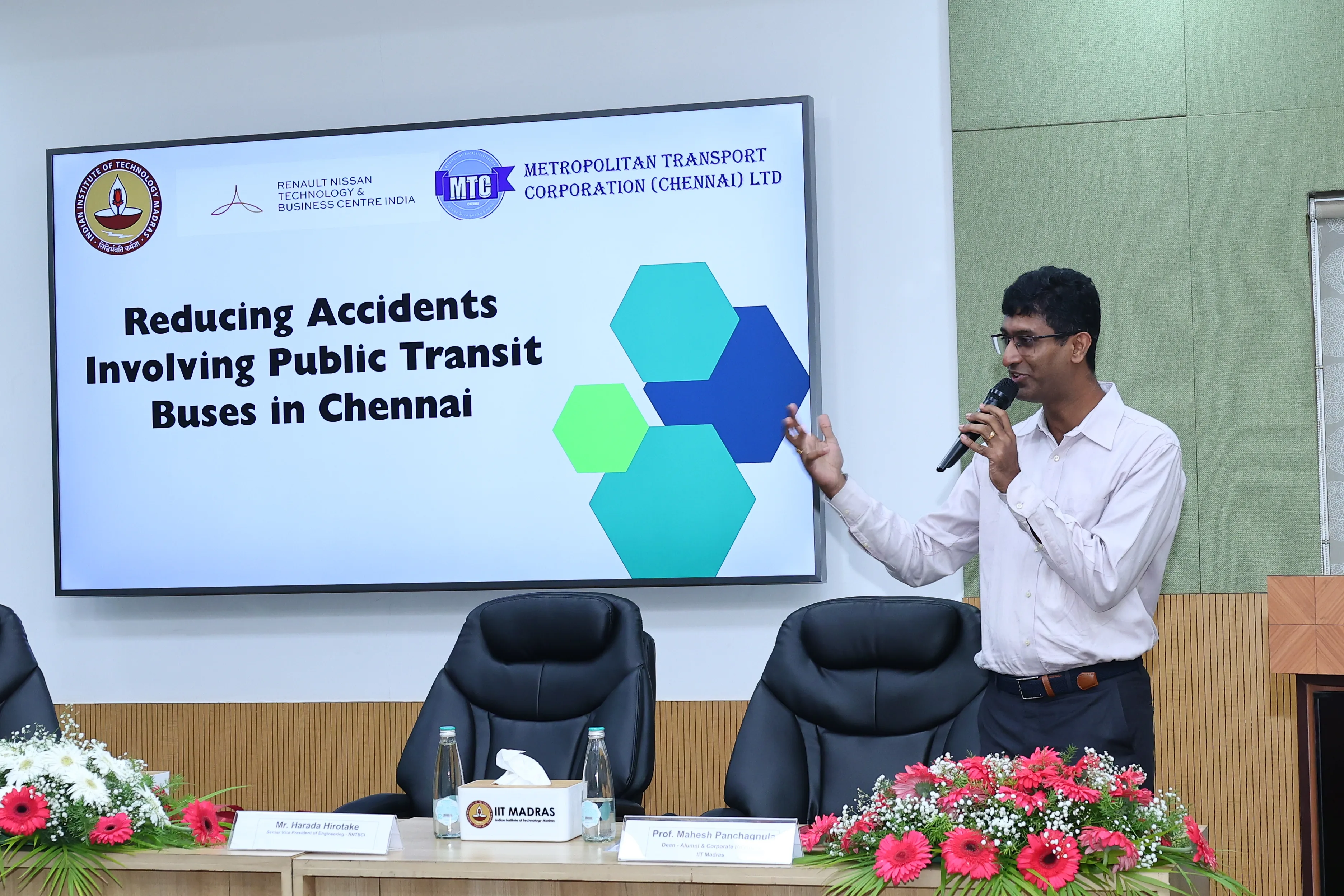
Supported by Renault Nissan Technology & Business Centre India (RNTBCI), IIT Madras launched a comprehensive research programme to understand and reduce accidents involving Chennai's Metropolitan Transport Corporation (MTC) buses.
The project combines large-scale accident analytics, driver health and behavioural assessments, physiological sensing, driving simulation and in-vehicle data collection to identify the factors influencing crash risk. By integrating historical accident records with real-time behavioural data, the initiative aims to develop practical interventions that improve public transport safety.
Driving Safer Mobility Through Research
The project adopts a multidisciplinary approach that brings together transportation engineering, behavioural science, artificial intelligence and human factors research.
Key components include:
- Analysis of over five years of MTC accident records
- Randomly selected cohort of 600 bus drivers for behavioural and health assessments
- Driver surveys covering physical, psychological and workplace factors
- Driving simulator experiments to evaluate risk scenarios
- Advanced sensing technologies including ECG, GSR, cameras, accelerometers and gyroscopes for real-world driver monitoring
- Data-driven models to recommend targeted safety interventions
Extending Innovation Beyond Research
To complement the research programme, IIT Madras launched Hack-cident, a nationwide innovation challenge inviting students, researchers and industry professionals to develop scalable road safety solutions.
The competition attracted 312 registered teams, with promising ideas progressing through multiple evaluation rounds. The best teams received funding to prototype and implement practical solutions capable of improving road safety in real-world environments.
Expected Impact
The initiative is creating a scientific framework for improving public transport safety by enabling:
- Evidence-based policies for accident reduction
- Better understanding of driver behaviour and fatigue
- Technology-enabled safety monitoring
- Practical interventions for public transport operators
- Innovation-driven solutions with potential for deployment across Indian cities
By combining rigorous research with open innovation, the project has the potential to transform how cities understand, predict and prevent public transport accidents.