

Department of Applied Mechanics and Biomedical Engineering (AMBE)
Project Overview
The project focuses on developing an indigenous ultrasound imaging system designed for maternal and fetal healthcare. The initiative aims to strengthen diagnostic capabilities by enabling reliable imaging for fetal monitoring and maternal health assessment. The work is being carried out at IIT Madras by a multidisciplinary team working across hardware design, software development, signal processing, and imaging technologies.
Project Development and Implementation
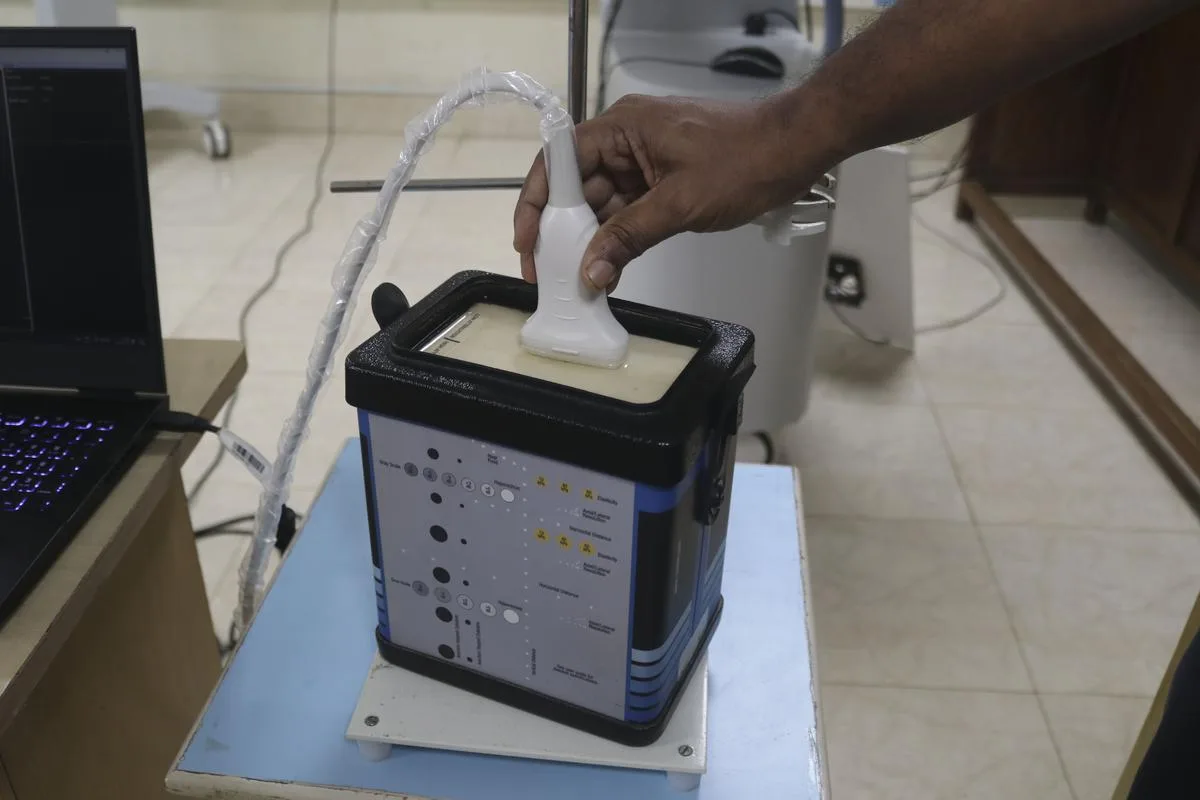
The project has focused on developing and refining the ultrasound hardware platform through iterative improvements in electrical and mechanical components. Enhancements have been implemented to improve system stability and imaging performance, including addressing signal noise and interference during data acquisition. Additional transducer probes operating at different frequency ranges have been integrated to support maternal and fetal imaging requirements.
Alongside hardware development, software modules have been designed and integrated to support system operation and imaging functionality. The team worked on debugging and optimizing hardware–software integration to improve image quality. Components such as the graphical user interface, keyboard interface, relay modules, and controller programming have been integrated to enable smooth system operation.
Imaging Features and System Capabilities
The system includes imaging features relevant to maternal and fetal healthcare. Demonstration modules have been developed for fetal gender masking and fetal biometry functions. A color flow imaging mode has also been implemented to visualize blood flow, with algorithms adapted to function with data obtained from the ultrasound hardware system. Efforts have also been made to improve data transfer mechanisms to support better frame rates and real-time imaging performance.
Signal Quality Improvements and Testing
The development process addressed challenges related to signal noise and interference. Through systematic troubleshooting, improvements such as shielding enhancements, hardware adjustments, and power supply refinements were implemented to enhance signal stability and image quality.
The ultrasound system has undergone testing to evaluate safety and performance parameters applicable to medical electronic devices. Initial testing results indicated that the system met most required parameters, and further validation activities are planned.
Conclusion
The project represents an important step toward developing advanced medical imaging technology within India. Through continuous hardware refinement, software integration, imaging feature development, and system testing, the project has progressed toward a functional ultrasound imaging prototype designed to support maternal and fetal healthcare applications.