
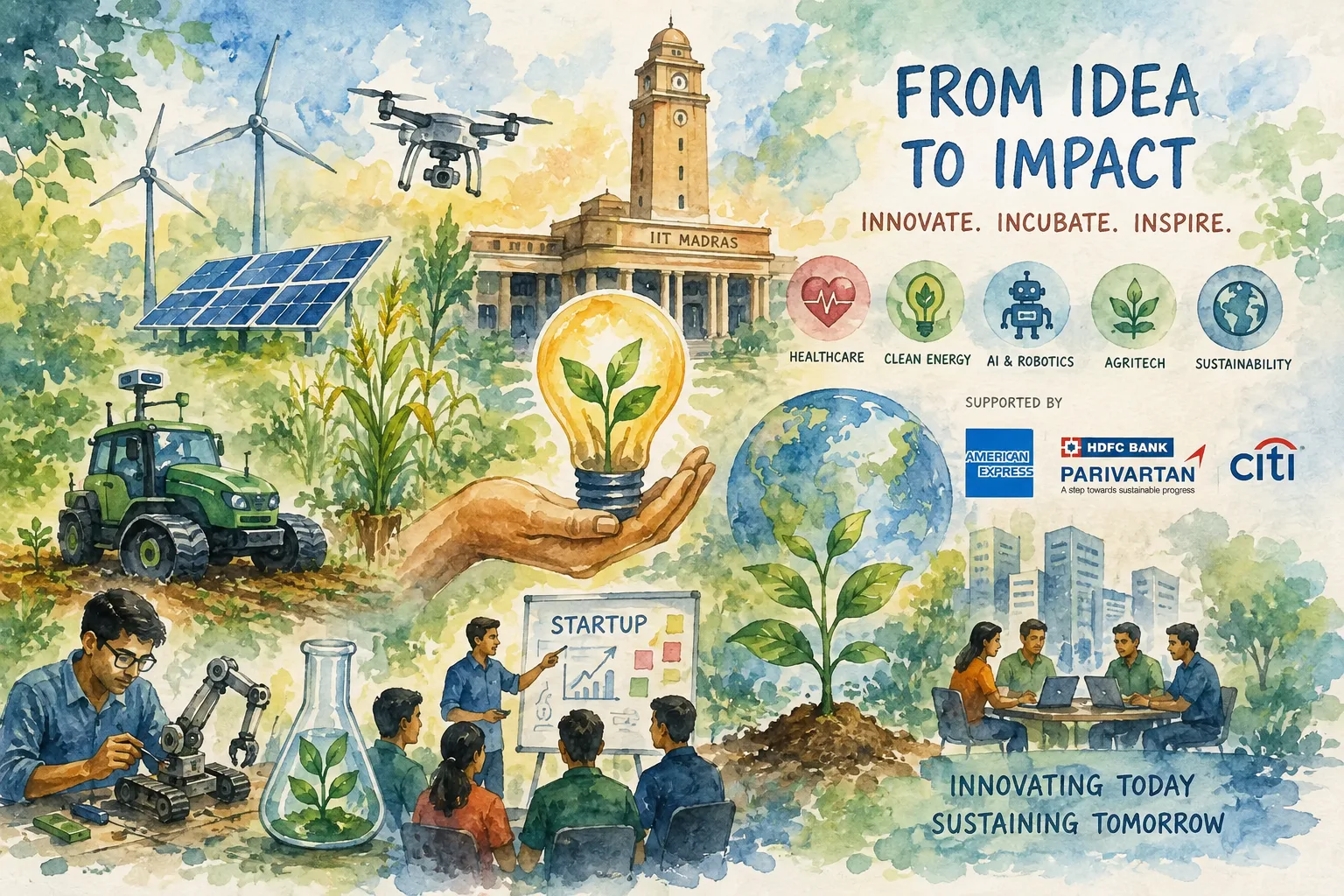
In nourishing and bringing to fruition the young innovator’s dream, IIT Madras’ Innovation and Incubation Program with CSR support from American Express (Amex), HDFC Bank Parivartan and Citibank, offers a prototype to incubation module, with structured mentoring and training, to make ideas market-ready (43 words)
For new ideas to flourish, an ecosystem of encouragement and support has to be created to bring the innovation to fruition. This is often a challenge in a country like India, where marketplaces are flooded with innovators, and excellence is often lost in translation.
Today, the focus is on reclaiming the earth for future generations. Sustainability in all ventures is a default expectation. There is a crying need for alternatives in almost every industry, which do not contaminate or damage the environment. The space therefore, is huge—with green being the leading mantra.
This is where IIT Madras stepped in with its Innovation and Incubation Program with CSR support from American Express (Amex), HDFC Bank Parivartan and Citibank. Separating wheat from the chaff, this initiative picked start-up ventures to support in early stage innovation, to fill the ‘idea-to-startup’ gap.
This program was implemented through the Office of Innovation and Entrepreneurship, along with Nirmaan (the pre-incubator at IITM) and IIT Madras Incubation Cell (IITMIC). Start-ups had to be aligned with the UN Sustainable Development Goals (SDGs), to be supported in this program.
The Innovation and Incubation Program was planned in such a way that student innovators received mentorship, technical validation, and early access to the ecosystem. They were supported to achieve scale, and to move from the academic incubation ecosystem, into national and global markets.
For any innovation to thrive, a strong ecosystem has to be created to support, mentor and sustain it. In today’s world, it does seem glamourous to be a start-up founder. This label frames an enterprising and innovative mindset. However, in the real world, such enterprise and innovation are not the easiest to sustain. Hard work, grit, determination, the will to stay the course—all these qualities and more are required to even walk the path that could lead to success.
Start-ups meeting the criteria were carefully chosen to be part of the program. Each of the chosen ventures were interesting and transformative, and were spread across real-world requirements in agriculture, climate action, industrial automation, healthcare, aerospace, digital empowerment, and inclusive economic growth.
They were assessed in a multi-stage evaluation process, on their market potential and impact, business model, product innovation, financial robustness, as well as social viability, among other parameters.
The basic need to sustain the program were well-thought out and put in place. Meaningful strides were made in building an ecosystem, creating institutional collaborations and structured engagement models that lead towards the sustainable and future-proof end use. Focus has been on partnerships with academic institutions, with stakeholders who would guide the build mechanisms and research pathways.
So it is not surprising that IITM has facilitated all these to ensure that a robust foundation is given for innovation, ensuring that the ecosystem is rooted in the values of growth and relevance.
Using cohort-based program, mentorship, and targeted training initiatives, students, faculty, and researchers have found meaning, being grounded in excellent support systems. Ultimately, a start-up idea has to serve widespread use and relevance in the real world to be successful and fulfil entrepreneurship goals. This program has shown itself to be adaptive, using the development of technology-led solutions aligned with real-world challenges.
The total allocation of funding for the program from Amex was Rs.8.46 crores. The focus sectors included healthcare, clean energy, AI and robotics, Agritech, as well as sustainability and climate. Individual grants ranged from Rs.5 lakhs to Rs.20 lakhs.
For example, one of the ventures that were supported by this Amex for this program, is Automagri Pvt Ltd. The start-up is developing electronic agricultural robots to not just supplement labour shortage, but also to make farming operations cost-effective. BotForge Labs Pvt Ltd for instance, is building Generalist Robot Foundation Models, intelligent machines that can learn, adapt and perform tasks across industries.
IndieRise Research Lab Private Limited is building Artificial Intelligence tools for content creation and filmmaking workflows. International Phytomedicine Innovation Private Limited is engaged in the development of plant-based medicines for healthcare solutions. The start-ups thus, encompass a wide range of industry and technology, showing promise of sustainable solutions for new world requirements.
HDFC Bank Parivartan has supported a portfolio of start-ups that have seen advancements in technology development, validation of pilot projects, and have demonstrated early-stage commercialisation. The CSR contribution from HDFC Bank Parivartan has been Rs.6.85 crores.
Commercial grade products have been finalised for multiple start-ups, while R&D is jogging along at a robust pace. Intellectual Property filings including provisional patent filings, are being done for some of the ventures.
Mentorship excellence, creating industry connects and processes for market validation ensure that the start-ups follow healthy processes, and are market relevant. For example, Inventive Scientific Minds LLP processes Multi Layer Packaging or MLP, transforming them into plastic and aluminium for further product development, ensuring that landfills are not contaminated with non-degenerative material.
Satiq Concrete Manufacturer Pvt. Ltd. makes low carbon concrete, geopolymer concrete products from agro waste, tiles, planters, etc. that aim at carbon footprint reduction.
Grants range from Rs.18 lakh to Rs.40 lakh per start-up, phased over utilisation and scaling. EarthFokus that works in the field of water and sustainability has shown remarkable progress, validated in real-world conditions, with eight enterprise clients in different stages, in the financial year 2025.
In what is a heartening development, start-ups have begun generating early revenues, with Monthly Recurring Revenue (MRR) ranging from ₹2 lakh to ₹5 lakh, projected to grow further in the coming quarters.
Citibank meanwhile, has broadly committed about Rs.30 crores towards Innovation to Incubation, and its focus is Agri-Tech, Clean-Tech & Fin-Tech start-ups. The approved grant for the financial year 2025–26 has been Rs.8.91 crores.
The first stage has been completed December 2025–February 2026, and focus has been on identification, onboarding, and development of start-up cohorts. Cohort 1 had 7 faculty and 20 researchers participate, while Cohort 2 is ongoing, in association with Banasthali Vidyapith. Focus has been on the strengthening of the academic-industry collaboration, and in expanding innovation-led partnerships.
Associations with STEM universities were created for knowledge enhancement, even as training sessions and outreach events were conducted along with entrepreneurial and accelerator workshops, to fully equip start-up founders with the skills that they require to last the long haul.
IIT Madras’ Innovation and Incubation Program has shown that investing in an start-up ecosystem can benefit founders and ventures, supporting not just skill-building but with grants and early stage funding. Championing innovators and aiding their transition from ideation to structured venture development, the programme has successfully engaged students, faculty, and researchers, strengthening the pipeline of innovation-driven startups.
The programme has also made meaningful strides in ecosystem building through institutional collaborations and structured engagement models. Partnerships with academic institutions and stakeholders have expanded the programme’s reach, facilitating knowledge exchange and supporting research commercialisation.
These efforts have contributed to building a robust foundation for innovation, while enhancing capacity across multiple levels of the ecosystem. Looking ahead, the programme is well-positioned to scale its impact with measurable outcomes.
This program has helped strengthen India’s deep-tech and innovation ecosystem. Every venture that was supported has promoted sustainability and viability, bringing in technological solutions across climate, energy, agriculture, healthcare, industry and more. It has encouraged digital inclusion and economic participation, enabling high-skill job creation and technological research, setting benchmarks that will only rise as success stories inspire and motivate more youngsters to dream big. (1,220 words)